
MDEL Rule Change blog

Canada’s MDEL Rules Are Changing December 14, 2026 —Here’s What Foreign Distributors Need to Know

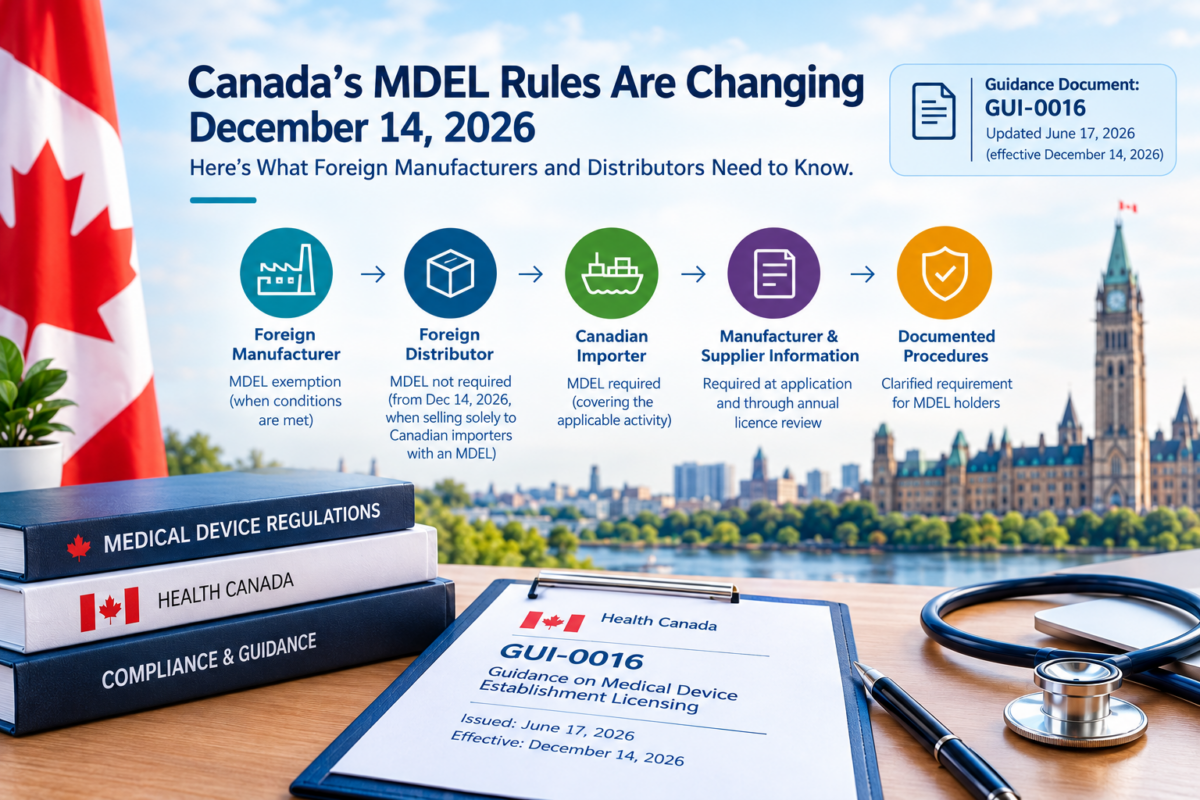
If you're building a Canadian market entry strategy around today's Medical Device Establishment Licence (MDEL) rules, you're planning against a regulation that's about to change. Health Canada finalized Phase 2 of its MDEL modernization on June 17, 2026, publishing the amended regulations (SOR/2026-110) in the Canada Gazette, Part II. They come into force December 14, 2026 — 180 days after publication.

This isn't a minor housekeeping update. It changes who needs an MDEL at all, what MDEL holders are required to track, and how "documented procedures" gets enforced. Here's what's actually in it.

1. Foreign Distributors Gain an Exemption Manufacturers Already Had

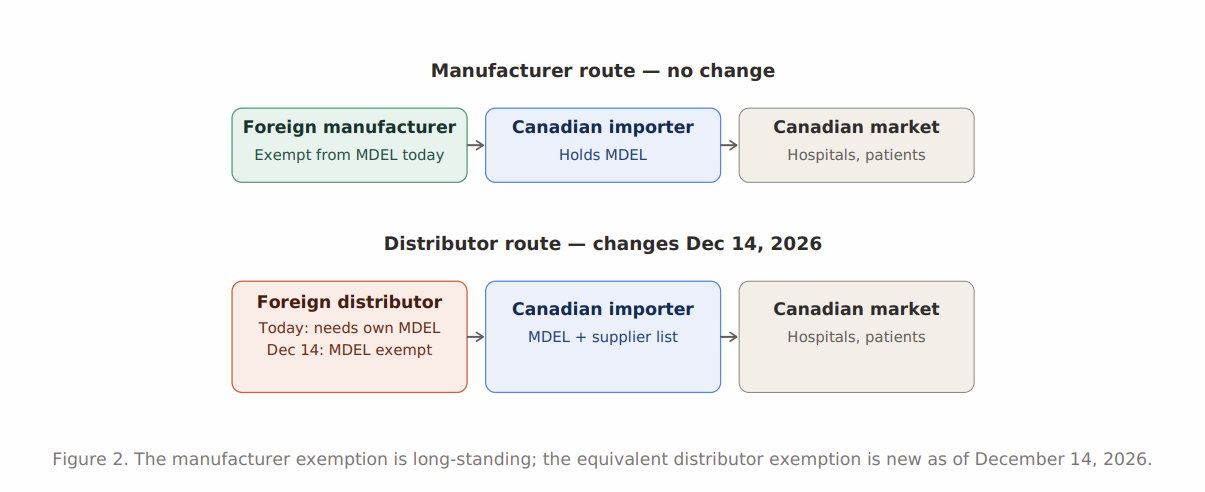
Foreign manufacturers already have this exemption today — it isn't new. Under section 44(4) of the Medical Devices Regulations, a foreign manufacturer selling through a Canadian importer that holds a valid MDEL does not need an MDEL of its own. This has been the rule before Phase 2 and continues unchanged after December 14, 2026.

Foreign distributors did not have that exemption. Under the current rules, a foreign distributor (a company selling a device it did not manufacture) generally needs its own MDEL, even when a Canadian importer is already involved. Phase 2 changes this: from December 14, 2026, a foreign distributor selling exclusively through a Canadian importer that already holds a valid MDEL will no longer need an MDEL of its own.

In short: Phase 2 extends an exemption that manufacturers already had to distributors—it does not eliminate the need for an MDEL somewhere in the chain. The Canadian importer's licence still has to cover the activity; what changes is who else in the chain is required to also hold one.
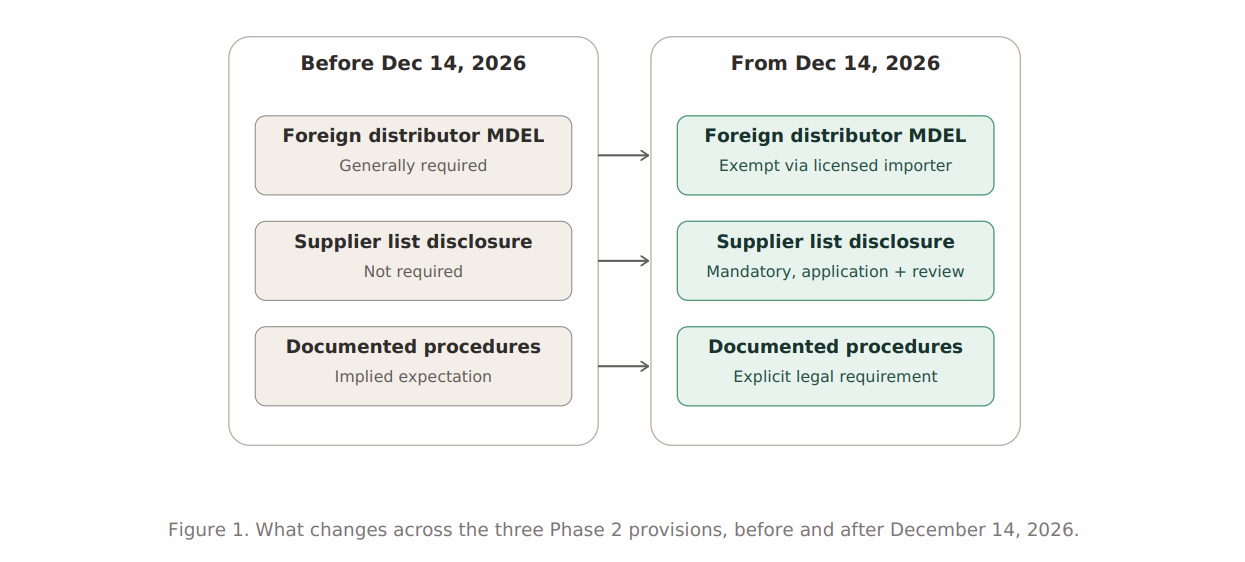
What changes across the three Phase 2 provisions, before and after December 14, 2026

A practical wrinkle: if the device is Class II, III, or IV, the manufacturer still needs a valid Health Canada Medical Device Licence (MDL) for the product itself—the MDL and the MDEL are separate authorizations, and the manufacturer exemption from holding an MDEL doesn't remove the need for an MDL where the device class requires one. Class I devices don't require an MDL, but the importer still needs an MDEL covering the import activity.

2. Supplier List Disclosure Becomes Mandatory

Starting December 14, 2026, MDEL applicants and holders must provide a list of the suppliers for the devices they import or distribute—both at initial application and at each licence review (ALR). This is a traceability measure: Health Canada wants visibility into who is supplying devices moving through Canadian commerce, not just who holds the licence.
For companies working with an MDEL-holding partner, this means your supplier information now needs to be complete, current, and ready to hand over on a recurring basis — not just a one-time disclosure at onboarding..

3. The Documented Procedures Requirement Is Being Clarified, Not Introduced

MDEL holders have long been expected to have documented procedures in place for their regulated activities. Phase 2 makes this an explicit legal requirement rather than an implied or attestation-based expectation.
This distinction matters. Companies that assumed their existing SOPs already satisfied Health Canada's expectations are the ones most likely to be caught off guard here — the obligation isn't new, but the bar for demonstrating compliance with it is about to be more clearly defined and enforced.

A Note on GUI-0016

Health Canada has published an updated version of GUI-0016, its guidance document on medical device establishment licensing, reflecting these Phase 2 changes. Important: this updated guidance does not take effect until December 14, 2026. Anyone consulting GUI-0016 before that date is reading a version of the guidance that isn't yet operative. Until then, the current version remains the applicable reference.

What This Means If You're Entering Canada Now

If you're a foreign medical device manufacturer or distributor building your Canadian go-to-market plan between now and December 2026, a few practical takeaways:

  • Confirm whether you're selling as the manufacturer or as a distributor of someone else's device — the two are on different timelines for this exemption, and the distinction determines whether you already qualify or have to wait until December 14, 2026.
  • If your strategy relies on a Canadian importer of record, confirm the importer's MDEL genuinely covers the import activity for your device's class.
  • For Class II, III, or IV devices, remember the MDL (product licence) requirement sits alongside the MDEL question, not instead of it.
  • Start organizing supplier information early — the annual review requirement means this becomes a recurring compliance task, not a one-time form.
  • Don't assume existing SOPs are sufficient. Review documented procedures against the amended regulatory text, not just the current guidance.
  • Track which version of GUI-0016 you're referencing, and confirm the effective date before relying on it for a submission or audit.

Getting the Timing Right

Regulatory transition windows like this one reward manufacturers and distributors who plan ahead of the in-force date rather than reacting to it. Whether you're structuring a new MDEL-based partnership or reassessing an existing one, understanding exactly what changes on December 14, 2026 — and what doesn't — is the difference between a smooth transition and a compliance scramble.

How Globyz Can Help

Globyz BioPharma Services holds an MDEL and provides licensed import, distribution, and 3PL support for medical device manufacturers and distributors entering the Canadian market. We're tracking the Phase 2 amendments closely and can help you assess how they affect your supply chain structure ahead of the December 2026 deadline.

Have questions about how these changes affect your Canadian market entry plan? Contact us to talk it through.
Your Medical Device Is Approved in Canada. So Why Can’tYou Sell It Yet?

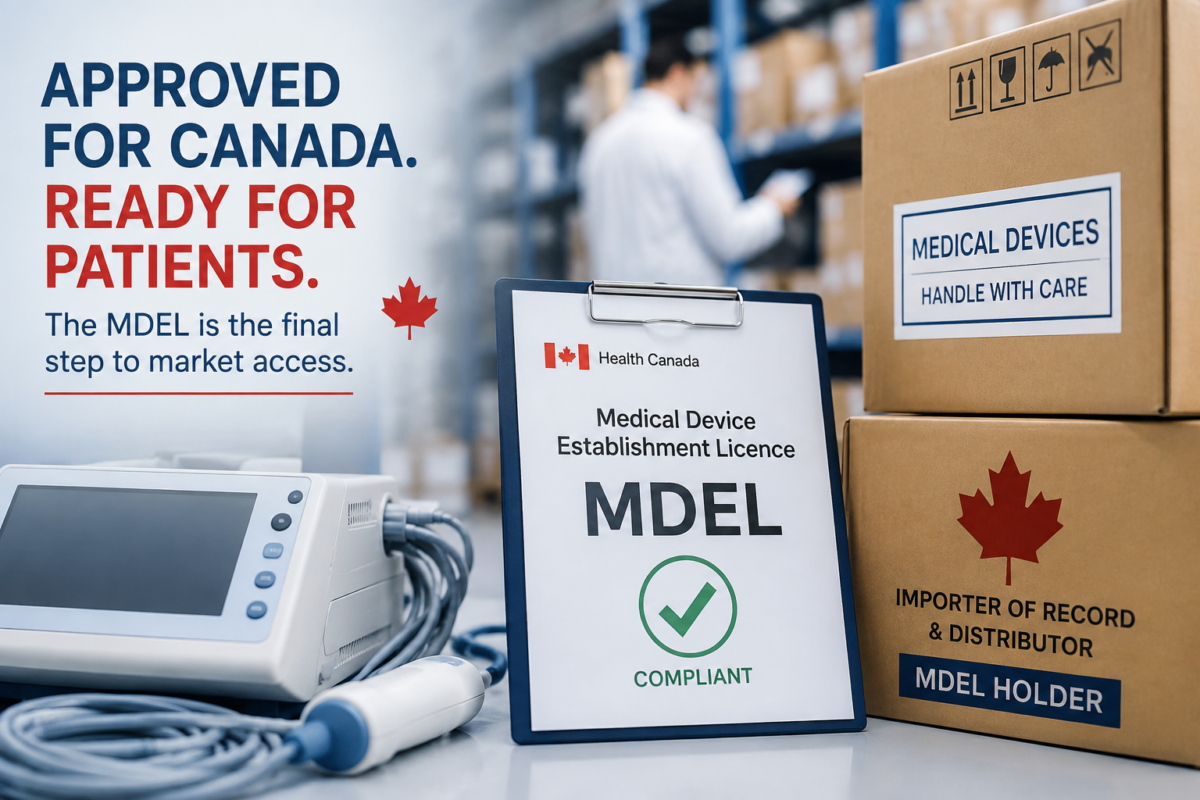
If you're a medical device manufacturer outside Canada, getting your device licensed is only half the job. Before a single unit can legally reach a Canadian hospital, clinic, or pharmacy shelf, someone in your supply chain needs to hold a Medical Device Establishment Licence (MDEL).

Device Licence ≠ Market Access

A Medical Device Licence from Health Canada confirms your device is approved for sale in Canada. It says nothing about who is allowed to import or distribute it. That authority belongs to the MDEL — a separate licence tied to the company and facility handling the device, not the product itself.

Without an MDEL holder in the chain, your device can't legally enter Canadian commerce, no matter how strong your approval is.

Why Most Foreign Manufacturers Don't Have One

Setting up your own MDEL means taking on a full slate of Canadian regulatory infrastructure before you've sold a single unit:

  • Establishing a Canadian entity or physical site
  • Building a Health Canada-compliant quality system
  • Passing a Health Canada facility inspection
  • Maintaining ongoing compliance, recordkeeping, and reporting

For a manufacturer testing the market or running a modest volume, that's a heavy lift to take on alone.

The Faster Path: Partner With an MDEL Holder

Globyz BioPharma Services holds an MDEL and acts as the licensed importer and distributor for medical device manufacturers entering Canada — handling the regulated activities while you focus on sales and clinical relationships. That means:

  • No need to stand up your own Canadian entity or licence to start selling
  • Compliant storage and distribution already in place
  • A path to launch as soon as your device is approved, with no infrastructure gap behind it

Start the MDEL Conversation Early

The manufacturers who launch fastest in Canada line up their MDEL partner before approval lands, not after. If you're bringing a medical device into the Canadian market, that's the first call worth making.

Globyz BioPharma Services holds an MDEL and provides licensed import, distribution, and 3PL support for medical device manufacturers entering Canada.

Ready to bring your device into the Canadian market? Contact us to get started.

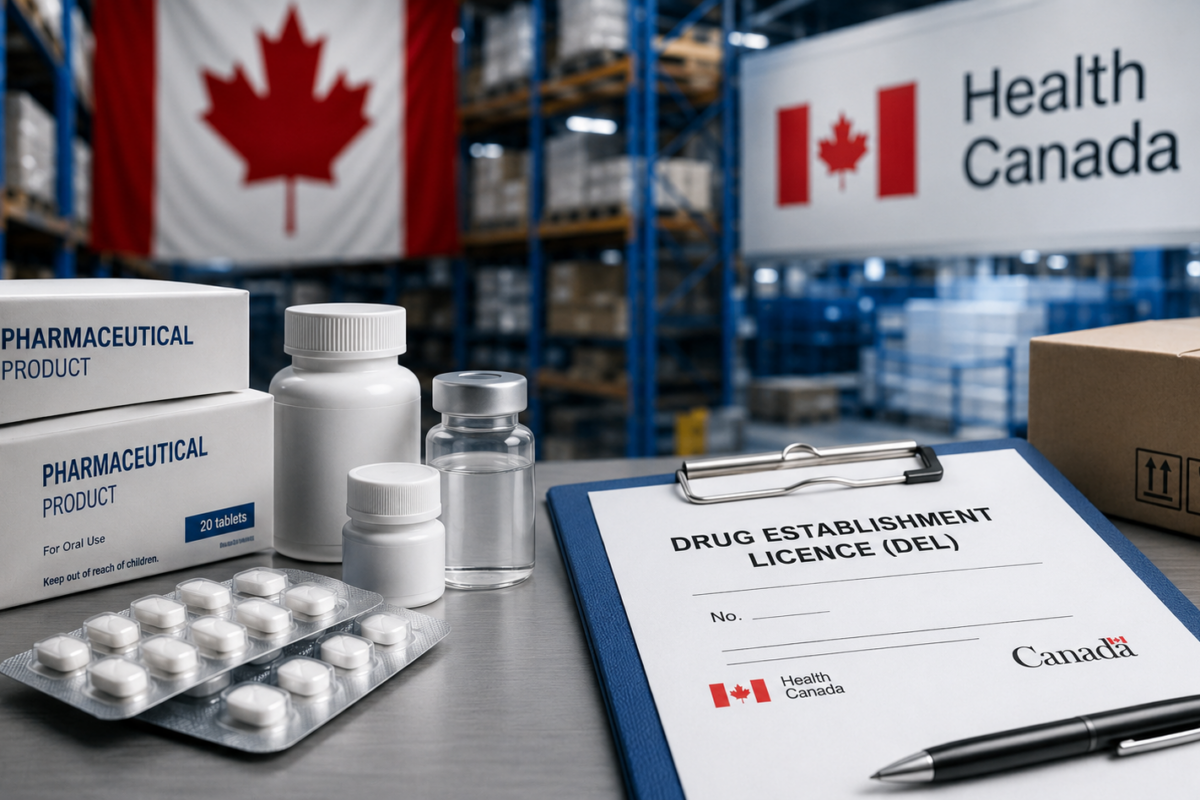
Do You Need a Drug Establishment Licence (DEL) to Sell Pharmaceuticals in Canada?

If you're a pharmaceutical or biotech company planning to sell products in Canada, one of the first regulatory questions you'll run into is whether you need a Drug Establishment Licence (DEL), and if so, how to get one. The answer depends on your business model, and getting it wrong can delay a launch by months.

What Is a DEL, and Who Needs One?

A Drug Establishment Licence is issued by Health Canada and is required for companies that fabricate, package/label, test, import, distribute, or wholesale drugs in Canada. If your company falls into any of these activities and doesn't already hold a DEL, you generally have two options:

  1. Apply for your own DEL. This process can take significant time, requires an established quality system, and typically only makes sense if you plan to run a full Canadian operation long-term.
  2. Partner with a company that already holds a DEL. This lets you bring products to market without the overhead of building and maintaining your own licensed facility.

Why Many Companies Skip Getting Their Own DEL

For pharma and biotech companies entering Canada for the first time, or running smaller volumes, setting up an independent DEL-holding operation often isn't practical. It means:

  • Paying tens of thousands of dollars in application fees before any product moves
  • Standing up (or contracting) a GMP-compliant facility
  • Building a Canadian quality system from scratch
  • Navigating an application and inspection timeline that can stretch launch dates well beyond a company's target window

For many companies, especially those testing the Canadian market with a smaller shipment or a single product line, working with an established DEL holder is significantly faster, lower-cost, and lower-risk.

How a Commercialization Partner Helps

Working with a partner who already holds a DEL means your product can move through import, storage, and distribution without your company needing its own licence in place. A good partner will typically handle:

  • Importation: acting as Importer of Record where needed
  • GMP-compliant storage and distribution: including cold-chain and temperature-controlled logistics where required
  • Regulatory and quality support: so your product stays compliant as it moves through the Canadian supply chain
  • Market access and commercialization support: helping you go from "approved" to "actually available to patients"

This is particularly useful for companies running pilot shipments to test demand before committing to a larger, recurring supply chain, a common first step before scaling into regular orders.

What to Look for in a DEL Partner

Not all DEL holders offer the same scope of service. When evaluating a partner, it's worth asking:

  • Do they hold an MDEL or DEL relevant to your product category?
  • Can they support both one-off pilot shipments and larger recurring volumes?
  • Do they offer end-to-end support (importation, storage, distribution, and regulatory), or just one piece of the puzzle?
  • What's their experience with your specific product type (biologics, specialty medicines, generics, etc.)?

How Globyz Can Help

Globyz BioPharma Services holds licensing in Canada and offers end-to-end commercialization support for pharmaceutical and biotech companies entering or expanding in the Canadian market, from importation and GMP-compliant 3PL warehousing to regulatory affairs support and market access. Whether you're planning a small pilot shipment to test the market or a full commercial launch, our team can help you move faster and avoid the upfront cost of building your own licensed infrastructure.

Curious whether your product needs a DEL, or whether a commercialization partner is the right fit? Contact Globyz to talk through your specific situation.